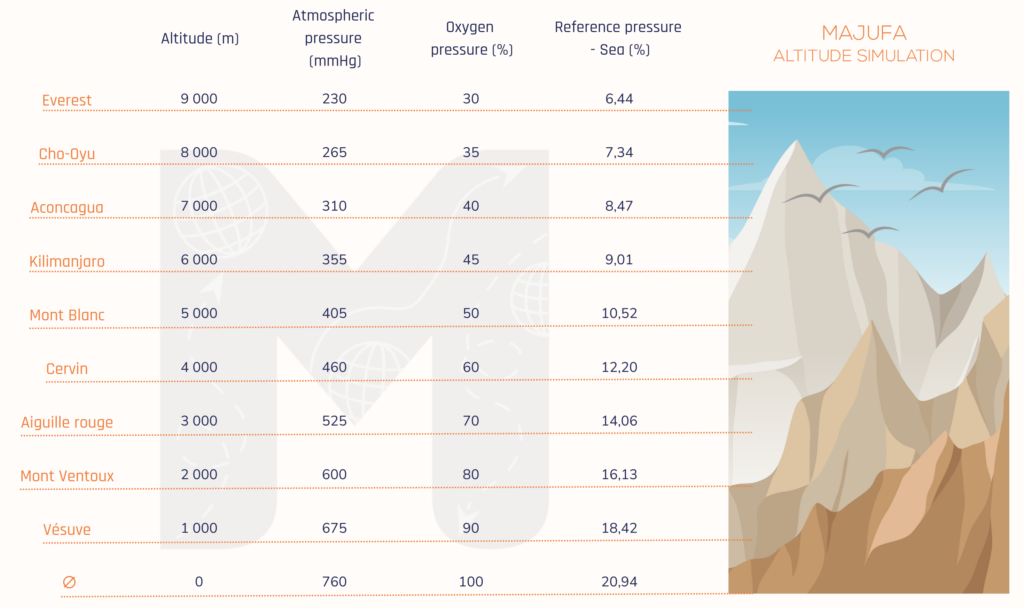
Majufa Simulation Altitude

AS AN EXPERT AND CONTRIBUTOR TO THE NF P90-400 STANDARD, I SECURE AND OPTIMISE YOUR HYPOXIA PROJECTS FROM A TO Z.

TRAINING UNDER HYPOXIA: WHAT ARE THE MAIN BENEFITS?

1. Improved aerobic endurance.

2. Enhanced respiratory and cardiovascular capacity.

3. Optimisation of anaerobic performance.

4. Improved muscular function.

5. Faster and more efficient recovery.

6. Beneficial hormonal adaptations.

7. Increased mental resilience.

For any use of hypoxic systems and the implementation of hypoxia exposure programmes for performance, wellbeing, or health purposes, it is essential to rely on existing scientific research and to seek the expertise of recognised specialists such as Dr. Samuel Verges, physiologist and co-author of this page.

I SUPPORT YOU THROUGHOUT YOUR HYPOXIA PROJECT

Analysis of objectives and definition of needs

I help you clarify your intended uses, constraints, and ambitions in order to define a precise functional need aligned with your performance, health, or research objectives.

Analyse des objectifs - hypoxie

Analyse des objectifs et définition du besoin

Je vous aide à clarifier vos usages, contraintes et ambitions afin de définir un besoin fonctionnel précis et aligné avec vos objectifs de performance, de santé ou de recherche.

Dimensionnement technique du système hypoxique

Technical sizing of the hypoxic system

I precisely size the system (flow rates, volumes, simulated altitude levels, safety parameters, etc.) to ensure a solution adapted to your space, practices, and technical requirements.

Feasibility study and budget framework

I deliver a comprehensive feasibility study and propose a realistic budget framework, covering all key cost items: equipment, construction works, maintenance, and user training.

Budget projet hypoxie

Étude de faisabilité et enveloppe budgétaire

Je rédige une étude de faisabilité complète et vous propose une enveloppe budgétaire réaliste, intégrant tous les postes clés : équipements, travaux, maintenance, formation.

Cahier des charges projet hypoxie

Drafting of a comprehensive technical specification document

I prepare a structured, clear, and complete technical specification document, forming the basis for supplier consultations and ensuring comparable and compliant offers.

Consultation with all manufacturers and installers on the market

I conduct an open, neutral, and exhaustive consultation of all specialised hypoxic system suppliers to guarantee fair and transparent competition.

Fabricants et installateurs

Consultation de tous les fabricants et installateurs du marché

Je réalise une consultation ouverte, neutre et exhaustive de l’ensemble des acteurs spécialisés en systèmes hypoxiques afin de garantir une mise en concurrence équitable et transparente.

Négociation

Support during negotiations

I assist you in analysing proposals, technical trade-offs, and negotiations in order to secure your decision and optimise the overall value for money.

Project monitoring and commissioning

I oversee the key project phases : installation, testing, commissioning, and user training, ensuring a controlled and compliant start-up.

Suivi de chantier hypoxie

Suivi de chantier et mise en service

Je pilote les phases clés du projet : installation, essais, mise en service et formation des utilisateurs, pour un démarrage maîtrisé et conforme à vos attentes.

Assistance technique

Technical assistance and follow-up contract

I provide personalised technical support and long-term follow-up after commissioning to guarantee performance, reliability, and optimal evolution of your hypoxic installation over time.

REFERENCES

HYPOXIC TRAINING – INDICATIVE EXAMPLES

The following examples are provided for illustrative purposes only.
MAJUFA ALTITUDE SIMULATION does not prescribe hypoxic training programmes.

Hypoxic interval session :

– 8 × 400 m at 90–95% MAS under hypoxia (15–16% simulated O₂, equivalent to 2,500–3,000 m altitude)

– 1 min 30 active recovery between intervals (walking or easy jogging)

– Objective : improve tolerance to high-intensity effort and recovery speed

Endurance run under mild hypoxia :

45 min at 70% HRmax under moderate hypoxia (17% O₂)

– Improves basic aerobic capacity without excessive fatigue

Technical work with intermittent hypoxia :

– 3 min of shadow boxing or heavy bag work under hypoxia (15% O₂)

– 1 min recovery under normoxic air

– 6 to 8 rounds

– Objective : maintain speed and power despite respiratory fatigue

Strength-endurance circuit :

Squats, push-ups, burpees, core exercises (20 seconds per exercise) under hypoxia

– 4 to 6 rounds with 1 min rest between circuits

Hypoxic sprint intervals :

10 × 30 seconds all-out under severe hypoxia (13–14% O₂)

– 2 min active recovery between efforts

– Objective : boost anaerobic capacity and sprint power

Long endurance sessions under mild hypoxia :

1h30 to 2h on an indoor trainer connected to a hypoxic system (17–18% O₂)

– Intensity at 65–70% FTP to reinforce the aerobic base

Small-sided games under hypoxia :

– 4 vs 4 on a reduced pitch under moderate hypoxia

– 4 × 5-minute bouts with 2-minute recovery under normoxic air

– Objective : develop running intensity and fast decision-making under fatigue

Repeated sprint ability :

12 × 30 m sprints under hypoxia with 20 s recovery

– Develops the ability to repeat explosive efforts with limited rest

Contact drills under hypoxia :

– Mauls, rucks, and tackles for 20 seconds under hypoxia (15% O₂)

– 40 seconds recovery

– 5 to 6 sets

– Objective : maintain power during contact phases under fatigue

“Defensive line speed” sequence :

– 20 m sprint → 10 m backpedal → 20 m sprint → tackle or line-out action

– 5 consecutive repetitions under hypoxia

– 2 min full recovery, 4 sets

Do you have a project in France or abroad?
I am available to discuss it with you from the earliest planning phase.